Build the rule in an editor. No SQL, nothing to release.
Every mission, streak and shop item asks the same question: does this customer qualify? You build that question yourself by picking from dropdowns, so a marketing manager can write it and no developer has to be involved.
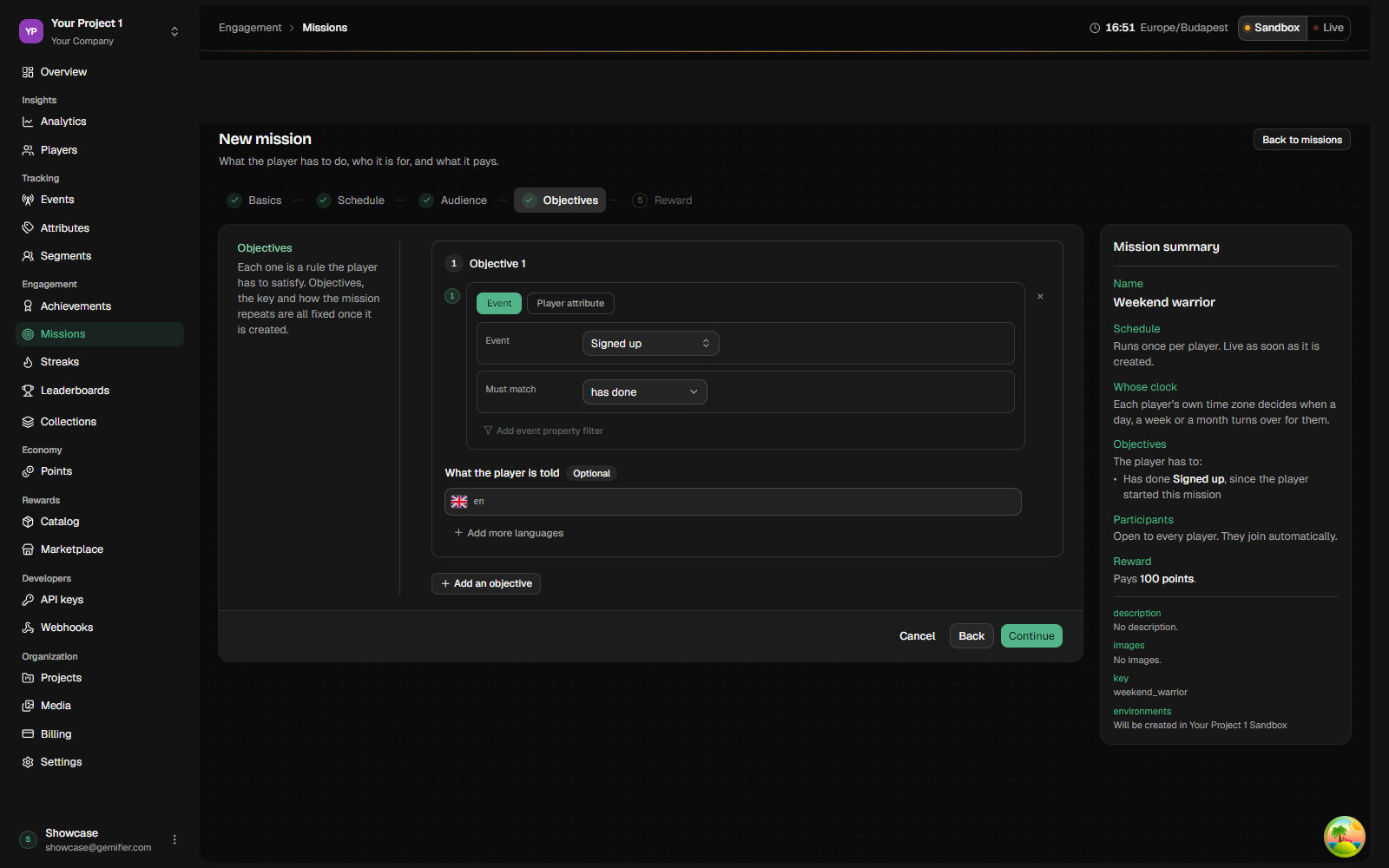
Every line is a thing, a comparison, and a value you choose.
Every line reads the same way, such as money spent, is at least, 50. Only the first part varies: it can be a fact you hold about the customer, a running total, what they did in a period, or a detail attached to one thing they did.
Something you know about them
Country, tier, signup source. You send them, and none of it has to be personal.
A number you track, since the beginning
Lifetime spend, orders placed, lessons finished. Leave the window off and it reads since the beginning, answered from a running total instead of a scan.
What they did in a period
Count, sum, average, lowest or highest, over a window you choose.
A detail on one thing they did
It narrows the question above: how much did they spend on card.
The same editor writes mission goals, streak days and eligibility.
A rule you can write for a mission goal, you write the same way for a streak day or for who may buy an item. Write it directly on one campaign and it stays its own copy, or name it once as a segment and point several campaigns at it, so editing the segment changes every one of them.
// readable names, and your own keys exactly as you named them:
// this is the tree the visual builder saves, written to be read.
// The API takes the same tree under its own field names
{
  "logicalOperator": "and",
  "conditions": [
    {
      "operand": {
        "type":    "eventAggregate",
        "eventKey": "purchase_amount",
        "function":  "sum",
        "window":    { "type": "currentCalendarPeriod", "unit": "month" },
        // per-event filter, same AND/OR builder
        "filter": {
          "logicalOperator": "and",
          "conditions": [
            {
              "operand":  { "type": "eventProperty", "propertyKey": "payment_method" },
              "operator": "equalTo",
              "value":    { "type": "text", "text": "card" }
            }
          ]
        }
      },
      "operator": "greaterThanOrEqualTo",
      "value":    { "type": "number", "number": 500 }
    },
    {
      "operand":  { "type": "playerAttribute", "attributeKey": "tier" },
      "operator": "in",
      "value":    { "type": "list", "list": ["gold", "platinum"] }
    },
    // this group could also be { "type": "segment", "segmentKey": "big-spender" },
    // a reference to a segment edited on its own screen. Written inline, it nests
    // as deep as the mechanic needs; a segment reference nests one level only.
    {
      "logicalOperator": "or",
      "conditions": [
        {
          "operand": {
            "type":    "eventAggregate",
            "eventKey": "purchase_amount",
            "function":  "sum",
            // no window: an unwindowed sum is the lifetime total
            "window":    { "type": "allTime" }
          },
          "operator": "greaterThan",
          "value":    { "type": "number", "number": 1000 }
        },
        {
          "operand": {
            "type":    "eventAggregate",
            "eventKey": "visits",
            "function":  "count",
            "window":    { "type": "rolling", "unit": "day", "amount": 7 }
          },
          "operator": "greaterThanOrEqualTo",
          "value":    { "type": "number", "number": 20 }
        }
      ]
    }
  ]
}
Tell us the rule you have never been able to write.
Describe it in your own words. We will build it in the editor during the call.